Milk thistle (Silybum marianum) seed extract is standardized to a flavonolignan complex called silymarin. This complex is not a single compound but a mixture of several closely related flavonolignans, the most abundant of which are silybin (also known as silibinin), silydianin, and silychristin. Together with minor constituents like isosilybin, these compounds account for the biological activity attributed to milk thistle supplements.[1][12]
Understanding the individual components of silymarin helps clarify how this botanical preparation may interact with liver cells. While silybin is the most studied and typically the most abundant, silydianin and silychristin contribute to the overall profile. This article outlines their chemical characteristics, proposed mechanisms, and what the current evidence base indicates about their respective roles.
Key Takeaways
- Silymarin is a mixture of flavonolignans, not a single compound; silybin, silydianin, and silychristin are the three primary constituents.
- Silybin is the most abundant and best studied, but silydianin and silychristin contribute to the complex’s overall profile and may have distinct properties.
- All flavonolignans in milk thistle have low oral bioavailability in their standard forms; enhanced formulations aim to address this limitation.
- Proposed mechanisms include antioxidant activity, membrane stabilization, and modulation of inflammatory and fibrotic pathways, primarily demonstrated in preclinical models.
- Human clinical data on individual flavonolignan contributions are limited; most evidence reflects the silymarin complex as a whole.
What Are Flavonolignans?
Flavonolignans are a class of natural products formed by the oxidative coupling of a flavonol (in this case, taxifolin) with a lignan precursor (coniferyl alcohol). This hybrid structure gives them properties of both flavonoids and lignans. In milk thistle seeds, these compounds accumulate in the protein layer of the seed coat and are extracted for use in dietary supplements.
The term silymarin refers to the total flavonolignan fraction extracted from milk thistle seeds, typically containing 65–80% flavonolignans by weight, with the remainder consisting of fatty acids, sugars, and other plant constituents. Standardization ensures consistent levels of the total flavonolignan content, though the ratios of individual isomers can vary between batches and manufacturers.[2]
Silybin (Silibinin): The Major Component
Silybin is typically the most abundant flavonolignan in silymarin, often comprising 50–60% of the total flavonolignan content. It exists as two diastereomers, silybin A and silybin B, which differ in configuration at a single chiral center. Both diastereomers are present in roughly equal amounts in standard extracts.[3]

Due to its prevalence, silybin has been the focus of the majority of in vitro and animal research on milk thistle. Studies have investigated its antioxidant capacity, its ability to modulate cellular signaling pathways involved in inflammation and fibrosis, and its interaction with membrane transporters. However, silybin has notably low oral bioavailability in humans, with plasma concentrations remaining in the low nanomolar range after standard doses. This pharmacokinetic limitation has prompted development of enhanced formulations such as silybin-phosphatidylcholine complexes.[4]
Silydianin: The Dehydro Conformer
Silydianin typically represents 10–15% of the total flavonolignans in silymarin. Structurally, it differs from silybin by the presence of a double bond in the lignan portion of the molecule, making it a dehydro derivative. This structural difference influences its polarity and chromatographic behavior, allowing separation from silybin during analytical testing.
Research on silydianin specifically is more limited than on silybin. Available in vitro data suggest it shares antioxidant and membrane-stabilizing properties with other flavonolignans, though its relative potency in various assays can differ. Some studies indicate silydianin may have distinct effects on certain enzyme systems or transporters, but human data are lacking. Its contribution to the overall effect of silymarin in vivo remains an area needing further investigation.[5]
Silychristin: The Third Major Isomer
Silychristin generally accounts for 10–15% of the flavonolignan fraction. It is a structural isomer of silydianin, with the double bond located in a different position within the lignan moiety. Like silydianin, it is a dehydro flavonolignan but with distinct stereochemistry.[6]
Preclinical studies have examined silychristin for antioxidant activity and effects on liver cell models. Some evidence suggests it may inhibit certain cytochrome P450 enzymes in vitro, which has implications for potential herb-drug interactions. However, as with silydianin, the clinical relevance of these findings at achievable human plasma concentrations is not well established. The isomer-specific contributions to silymarin’s overall pharmacology remain incompletely characterized.[13][14]

Minor Flavonolignans and Taxifolin
In addition to the three major flavonolignans, silymarin contains minor isomers such as isosilybin A and B, isosilydianin, and isosilychristin. These are stereoisomers or positional isomers formed during extraction or storage. The flavonoid precursor taxifolin (dihydroquercetin) is also present in small amounts and contributes to the antioxidant profile.[7]
While these minor constituents are typically not quantified in routine quality control, they may have additive or synergistic effects. Some research suggests that the full silymarin complex behaves differently than isolated silybin in certain biological models, supporting the concept of a multi-component botanical preparation rather than a single active ingredient.[5]
Proposed Mechanisms of Action
The flavonolignans in silymarin are proposed to support liver health through several complementary mechanisms. As antioxidants, they can scavenge free radicals and reactive oxygen species, and they may enhance endogenous antioxidant systems such as glutathione. Their planar structure allows intercalation into lipid bilayers, where they may stabilize hepatocyte membranes against toxin-induced permeability changes.[8]
Additional mechanisms under investigation include modulation of inflammatory signaling (such as NF-κB pathway inhibition), antifibrotic effects via stellate cell modulation, and regulation of protein synthesis through ribosomal RNA polymerase I activity. Most mechanistic data come from cell culture and animal models; translation to human physiology at supplemental doses requires further study.[8][12]
Bioavailability and Metabolism Considerations
All major flavonolignans in silymarin share poor oral bioavailability due to low water solubility, extensive phase II metabolism (glucuronidation and sulfation), and biliary excretion. Peak plasma concentrations of conjugated metabolites typically occur 1–3 hours post-dose, with unconjugated (free) forms representing a small fraction. Enterohepatic recirculation contributes to prolonged exposure in the liver and intestinal tract.[9][10]
Formulation strategies to improve absorption include complexation with phospholipids (phytosomes), micronization, and inclusion in lipid-based delivery systems. These approaches can increase area-under-the-curve (AUC) for total flavonolignans several-fold compared to standard extracts. However, clinical outcome data comparing formulations remain limited.[11]

🛒 Where to Buy Milk Thistle (Silymarin)
- CleanseParasites Heavy Metal + Microplastics Binder Editor’s Pick
Contains milk thistle alongside spirulina, zeolite, and other binder herbs. - Thorne Siliphos (Silybin Phosphatidylcholine Complex)Lab-tested / studied
capsules, 1 capsule (~120mg silybin-phosphatidylcholine complex) — Clinically-studied phospholipid complex form used in bioavailability research; NSF Certified for Sport option - Jarrow Formulas Milk Thistle 150mg (Silymarin Standardized Extract)
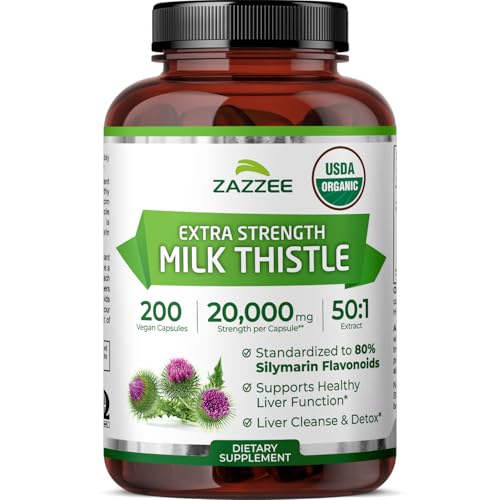
capsules, 1 capsule (150mg, 80% silymarin) — Widely used, third-party tested, standard 80% silymarin extract at an accessible price - NOW Foods Silymarin Milk Thistle Extract 150mg
capsules, 1 capsule (150mg, 80% silymarin) — GMP-certified, budget-friendly staple brand with consistent standardization - Nature’s Way Milk Thistle Thisilyn Standardized Extract
capsules, 1 capsule (175mg, 80% silymarin) — Long-running standardized formula, one of the most established milk thistle brands in the US market
As an Amazon Associate we earn from qualifying purchases. Quality varies widely — always choose a product with a published third-party test (COA) before buying.
A Note on the Evidence
Milk thistle supplements are not FDA-evaluated for safety or effectiveness and are not intended to diagnose, treat, cure, or prevent any disease. Flavonolignans can interact with CYP450-metabolized medications (including some statins, diabetes drugs, and hormonal therapies). Individuals with ragweed/Asteraceae allergies or diagnosed liver disease should consult a physician before use. This content is informational, not medical advice.[14]
Frequently Asked Questions
Is silybin the same as silymarin?
No. Silymarin is the total flavonolignan extract from milk thistle seeds, while silybin is a single flavonolignan that typically makes up 50–60% of that extract. Silymarin also contains silydianin, silychristin, and minor isomers.
Do silydianin and silychristin have the same effects as silybin?
They share structural similarities and overlapping antioxidant and membrane-stabilizing properties, but preclinical data suggest differences in potency and enzyme interactions. Their specific clinical contributions are not well defined.
Why does bioavailability matter for milk thistle supplements?
Low bioavailability means only small amounts of free flavonolignans reach systemic circulation after oral dosing. This limits exposure to target tissues and has driven development of enhanced-absorption formulations.
Are there clinical trials on isolated silydianin or silychristin?
Very few, if any, human trials have evaluated isolated silydianin or silychristin. Most clinical research uses standardized silymarin extract or silybin-phosphatidylcholine complexes.
Can the ratio of flavonolignans vary between products?
Yes. While total flavonolignan content is standardized, the relative ratios of silybin, silydianin, and silychristin can differ based on seed source, harvest conditions, and extraction method.
Should I choose a product standardized to silybin or to total silymarin?
Most clinical research has used extracts standardized to total silymarin (70–80% flavonolignans). Products standardized only to silybin content may not reflect the full composition used in studies.
References
- Lee JI et al. Separation and characterization of silybin, isosilybin, silydianin and silychristin in milk thistle extract by liquid chromatography-electrospray tandem mass spectrometry. Journal of chromatography. A (2006). PMID 16631762
- Chen W et al. Determination of Flavonolignan Compositional Ratios in Silybum marianum (Milk Thistle) Extracts Using High-Performance Liquid Chromatography. Molecules (Basel, Switzerland) (2024). PMID 38998902
- Lee DY et al. Molecular structure and stereochemistry of silybin A, silybin B, isosilybin A, and isosilybin B, Isolated from Silybum marianum (milk thistle). Journal of natural products (2003). PMID 14510591
- Bijak M et al. Silybin, a Major Bioactive Component of Milk Thistle (Silybum marianum L. Gaernt.)-Chemistry, Bioavailability, and Metabolism. Molecules (Basel, Switzerland) (2017). PMID 29125572
- Deep G et al. Identifying the differential effects of silymarin constituents on cell growth and cell cycle regulatory molecules in human prostate cancer cells. International journal of cancer (2008). PMID 18435416
- Johannes J et al. Silychristin, a Flavonolignan Derived From the Milk Thistle, Is a Potent Inhibitor of the Thyroid Hormone Transporter MCT8. Endocrinology (2016). PMID 26910310
- Vrba J et al. Identification of Human Sulfotransferases Active towards Silymarin Flavonolignans and Taxifolin. Metabolites (2020). PMID 32806559
- Wadhwa K et al. Mechanistic Insights into the Pharmacological Significance of Silymarin. Molecules (Basel, Switzerland) (2022). PMID 36014565
- Calani L et al. Absorption and metabolism of milk thistle flavanolignans in humans. Phytomedicine : international journal of phytotherapy and phytopharmacology (2012). PMID 23072776
- Vrba J et al. Metabolism of flavonolignans in human hepatocytes. Journal of pharmaceutical and biomedical analysis (2018). PMID 29414024
- Javed S et al. Reassessing bioavailability of silymarin. Alternative medicine review : a journal of clinical therapeutic (2011). PMID 21951025
- Křen V et al. Silybin and its congeners: from traditional medicine to molecular effects. Natural product reports (2022). PMID 35510639
- Jancová P et al. Silybin is metabolized by cytochrome P450 2C8 in vitro. Drug metabolism and disposition: the biological fate of chemicals (2007). PMID 17670841
- Doehmer J et al. Assessment of drug-drug interaction for silymarin. Toxicology in vitro : an international journal published in association with BIBRA (2008). PMID 18249085
These statements have not been evaluated by the Food and Drug Administration. This information is not intended to diagnose, treat, cure, or prevent any disease. Content is for informational purposes only and is not medical advice; consult a qualified healthcare provider before starting any supplement. As an Amazon Associate we earn from qualifying purchases.