Milk thistle (Silybum marianum) belongs to the Asteraceae (Compositae) plant family, which includes ragweed, chrysanthemums, marigolds, and daisies. This taxonomic relationship raises theoretical concerns about cross-reactivity in individuals with known Asteraceae allergies, though clinical data specifically documenting ragweed–milk thistle cross-reactivity remains limited.
This article reviews the published evidence on milk thistle hypersensitivity, including case reports of skin, respiratory, and anaphylactic reactions, and contrasts these findings with preclinical data showing that silymarin—the standardized flavonolignan complex from milk thistle seeds—exerts immunomodulatory and anti-allergic effects in experimental models. The goal is to present what is documented, what is theoretical, and where evidence gaps remain.
Key Takeaways
- Four published case reports document milk thistle hypersensitivity, and the reactions are not confined to the skin: alongside urticaria and acute generalized exanthematous pustulosis, a 2025 report describes anaphylaxis after ingestion of milk thistle seed [1] and a 2020 report describes respiratory symptoms after inhaling ground milk thistle [2]. None of the four establishes ragweed cross-reactivity.
- Preclinical studies consistently show silymarin and silybin suppress allergic inflammation (e.g., reduced eosinophils, Th2 cytokines, IgE) in mouse models.
- Milk thistle belongs to the Asteraceae family, creating theoretical cross-reactivity concern, but clinical data on ragweed-allergic patients reacting to standardized seed extracts are absent.
- Individuals with known Asteraceae allergies should consult a physician before use, consider patch testing, and discontinue at any sign of hypersensitivity.
- No controlled trials or component-resolved allergy studies exist to quantify cross-reactivity risk; current guidance is precautionary, not evidence-derived.
Documented Cases of Milk Thistle Hypersensitivity
Four published case reports describe allergic reactions attributed to milk thistle preparations. Two are cutaneous. A 1990 report documented urticaria in a patient receiving Carsil, a silymarin-containing product, with symptom resolution upon discontinuation [3]. A 2011 case described acute generalized exanthematous pustulosis (AGEP) following consumption of milk thistle tea, confirmed by patch testing and drug provocation [4].
The other two reach beyond the skin, and they matter more for anyone deciding whether milk thistle is safe for them. A 2025 case report from a hospital allergy department in Barcelona, indexed under the keywords anaphylaxis and food allergy, describes anaphylaxis induced by ingestion of milk thistle seed [1]. That is a short research letter and the published record does not describe the patient’s history or the mechanism, so nothing further should be read into it than what it reports: the seed, eaten, produced anaphylaxis in at least one person. Separately, a 2020 report described a 29-year-old man with occupational exposure who developed sneezing, runny nose, watering and burning eyes, and wheezing after inhaling ground milk thistle. Skin testing with native material was strongly positive for milk thistle, at a wheal of 16 mm against a 3 mm histamine control and a negative control of 0 [2].
Taken together these confirm that IgE-mediated or T-cell-mediated hypersensitivity to milk thistle can occur, that it can be systemic rather than only cutaneous, and that it has been reported from the seed itself and not only from whole-herb or tea preparations. None of the four establishes cross-reactivity with ragweed or other Asteraceae pollens specifically.
Immunomodulatory and Anti-Allergic Effects of Silymarin in Preclinical Models
Contrasting the case reports, multiple preclinical studies demonstrate that silymarin and its major constituent silybin (silibinin) can suppress allergic inflammation and modulate immune responses. In a murine model of ovalbumin-induced allergic airway inflammation, silibinin significantly reduced eosinophilic infiltration, Th2 cytokines (IL-4, IL-5, IL-13), and immunoglobulin E levels [5]. A 2017 review characterized silymarin as an immunomodulator affecting multiple immune cell types, including mast cells, dendritic cells, and T lymphocytes, with context-dependent effects that can be either immunostimulatory or immunosuppressive [6].

Additional mouse-skin studies showed that topical silymarin prevented ultraviolet-B-induced immune suppression and oxidative stress, suggesting preservation of normal immune surveillance [7]. These mechanistic data indicate that silymarin constituents possess intrinsic anti-allergic and immune-regulatory properties in experimental systems, which complicates a simple classification of milk thistle as a uniform allergen risk for Asteraceae-sensitive individuals.
Theoretical Cross-Reactivity: Asteraceae Family Membership and Clinical Reality
Milk thistle is a member of the Asteraceae family, the same botanical family that includes common allergenic plants such as ragweed (Ambrosia artemisiifolia), mugwort, and chamomile. Cross-reactivity within this family is well-documented for pollen allergens (e.g., profilins, polcalcins) and certain food-pollen syndromes. However, the milk thistle supplements used clinically are typically seed extracts standardized to silymarin (flavonolignans), not whole-plant or pollen preparations. The 2007 review of milk thistle advances noted its favorable safety profile in clinical trials but did not report systematic data on Asteraceae cross-reactivity [8]. The published literature on this question is limited to case reports rather than controlled studies measuring reaction rates in ragweed-sensitized people.
Context of Use: HIV and Integrative Settings
A 1999 perspective on improving highly active antiretroviral therapy (HAART) outcomes with natural products mentioned milk thistle as a hepatoprotective adjunct but did not address allergy or cross-reactivity [9]. This reflects the broader pattern in the literature: milk thistle is frequently studied for liver support and drug-interaction potential, while its allergenic potential—especially in atopic subgroups—receives less systematic investigation.
Practical Guidance for Individuals with Asteraceae Sensitivities
Given the theoretical risk and the four published case reports, which range from urticaria to anaphylaxis, individuals with known Asteraceae (ragweed, chrysanthemum, marigold, daisy) allergies should exercise caution. A prudent approach includes: (1) consulting a healthcare provider before initiating milk thistle, especially if there is a history of severe atopy or anaphylaxis; (2) considering a supervised graded challenge or patch testing if clinical uncertainty exists; (3) selecting products with clear labeling of plant part (seed vs. aerial parts) and standardization to silymarin, as pollen contamination is more likely in whole-herb or aerial-part preparations; and (4) discontinuing use immediately if urticaria, angioedema, respiratory symptoms, or widespread pustular eruption develop.

Evidence Gaps and Future Research Directions
The current evidence base contains no prospective studies measuring specific IgE to milk thistle seed extract in ragweed-sensitized cohorts, no component-resolved diagnostics identifying shared allergenic proteins between ragweed pollen and silymarin preparations, and no population-level data on reaction rates in Asteraceae-allergic consumers. The contrast between rare case reports of hypersensitivity and consistent preclinical anti-allergic effects of silymarin underscores the need for mechanistic allergy research—specifically, whether flavonolignans themselves can act as haptens or whether reactions are driven by residual pollen proteins in less-purified extracts. Until such data exist, clinical decisions must rely on individualized risk assessment rather than definitive cross-reactivity statistics.
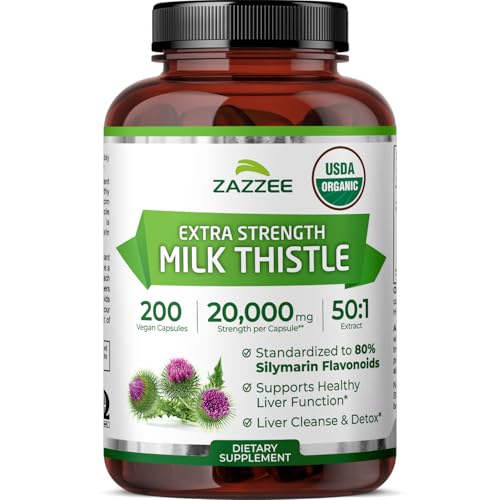
🛒 Where to Buy Milk Thistle (Silymarin)
- CleanseParasites Heavy Metal + Microplastics Binder Editor’s Pick
Contains milk thistle alongside spirulina, zeolite, and other binder herbs. - Thorne Siliphos (Silybin Phosphatidylcholine Complex)
capsules, 1 capsule (~120mg silybin-phosphatidylcholine complex) — Phospholipid complex form (silybin bound to phosphatidylcholine) for liver support - Jarrow Formulas Milk Thistle 150mg (Silymarin Standardized Extract)
capsules, 1 capsule (150mg, 80% silymarin) — Widely used, standard 80% silymarin extract at an accessible price - NOW Foods Silymarin Milk Thistle Extract 150mg
capsules, 1 capsule (150mg, 80% silymarin) — Made under NOW’s GMP Quality Assured program, budget-friendly staple brand with consistent standardization - Nature’s Way Milk Thistle Thisilyn Standardized Extract
capsules, 1 capsule (175mg, 80% silymarin) — Long-running standardized formula, one of the most established milk thistle brands in the US market
As an Amazon Associate we earn from qualifying purchases. Quality varies widely — always choose a product with a published third-party test (COA) before buying.

A Note on the Evidence
Milk thistle supplements are not FDA-evaluated for safety or effectiveness and are not intended to diagnose, treat, cure, or prevent any disease. They can interact with CYP450-metabolized medications (including some statins, diabetes drugs, and hormonal therapies). Individuals with ragweed/Asteraceae allergies or diagnosed liver disease should consult a physician before use. This article is informational, not medical advice.
Frequently Asked Questions
Does milk thistle contain ragweed pollen?
Milk thistle supplements are typically standardized seed extracts (silymarin), not whole-plant or pollen products, and ragweed pollen contamination has not been documented in the published literature. Do not read that as meaning the seed is inert: a 2025 case report describes anaphylaxis induced by ingestion of milk thistle seed [1], so choosing a seed extract over an aerial-part preparation removes a theoretical pollen-contamination route, not the possibility of reacting to milk thistle itself.
Can silymarin itself cause an allergic reaction?
Yes, and not only on the skin. Four case reports describe reactions attributed to milk thistle: urticaria and AGEP [3][4], respiratory symptoms after inhaling ground milk thistle [2], and anaphylaxis after ingesting milk thistle seed [1]. Reactions are rare relative to how widely the supplement is used, but the reported ceiling is anaphylaxis, not rash.
Is it true that silymarin has anti-allergic effects?
In mouse models, silybin reduced eosinophilic airway inflammation, Th2 cytokines, and IgE levels [5], and a review characterized silymarin as an immunomodulator with context-dependent effects on mast cells and T cells [6]. Human allergy prevention data are lacking.
Should I avoid milk thistle if I have a ragweed allergy?
Current guidelines suggest caution and physician consultation due to theoretical cross-reactivity within the Asteraceae family. The available published data do not quantify the actual risk for ragweed-sensitized individuals using standardized seed extracts.
Are there tests to predict if I will react to milk thistle?
Not as an off-the-shelf test. No validated predictive test (specific IgE, component-resolved diagnostics) for milk thistle allergy in ragweed-allergic patients has been described, and the 2020 case report states directly that no commercially available standardized test for milk thistle exists anywhere [2]. Diagnosis has still been achieved: in that case an allergist performed prick-to-prick skin testing using the patient’s own native material, which was strongly positive, and patch testing was used diagnostically in the AGEP case [4]. If you want to be tested, the realistic route is an allergist willing to test with the actual product, not a panel you can order.
What symptoms should prompt stopping milk thistle?
Stop immediately and seek emergency care for difficulty breathing, throat or tongue swelling, faintness, or any reaction involving more than one body system, since anaphylaxis after milk thistle seed ingestion has been reported [1]. Stop and contact a clinician for urticaria, angioedema, widespread pustular rash (AGEP), or new respiratory symptoms such as wheezing or persistent sneezing and eye irritation around handling the powder [3][4][2].
References
- Planas-Vinos M et al. Anaphylaxis Induced by Milk Thistle (Silybum marianum) Seed Ingestion: A Case Report. Journal of investigational allergology & clinical immunology (2025). PMID 40036083
- Wojas O et al. A case of allergy to Silybum marianum (milk thistle) and Eragrostis tef (teff). Allergy, asthma, and clinical immunology (2020). PMID 32322285
- Mironets VI et al. [A case of urticaria during carsil treatment]. Vrachebnoe delo (1990). PMID 2238610
- Ramírez-Santos A et al. [Acute generalized exanthematous pustulosis due to milk thistle (Silybum marianum) tea]. Actas dermo-sifiliograficas (2011). PMID 21641565
- Choi YH et al. Silibinin attenuates allergic airway inflammation in mice. Biochemical and biophysical research communications (2012). PMID 22842463
- Esmaeil N et al. Silymarin impacts on immune system as an immunomodulator: One key for many locks. International immunopharmacology (2017). PMID 28672215
- Katiyar SK et al. Treatment of silymarin, a plant flavonoid, prevents ultraviolet light-induced immune suppression and oxidative stress in mouse skin. International journal of oncology (2002). PMID 12429970
- Post-White J et al. Advances in the use of milk thistle (Silybum marianum). Integrative cancer therapies (2007). PMID 17548789
- Lichtenstein BS et al. Improving HAART naturally. STEP perspective (1999). PMID 11366744
These statements have not been evaluated by the Food and Drug Administration. This information is not intended to diagnose, treat, cure, or prevent any disease. Content is for informational purposes only and is not medical advice; consult a qualified healthcare provider before starting any supplement. As an Amazon Associate we earn from qualifying purchases.