Milk thistle is one of the most commonly used supplements among people who also take a statin, often because both are framed around “liver support.” But the two don’t just sit side by side in the body: the flavonolignans in silymarin (milk thistle’s active extract, including silibinin) interact with the same transport proteins that move many statins into liver cells, which is the mechanism researchers actually study when they ask whether this combination is safe.
This article looks at what’s known about that mechanism, what animal and early human data show for specific statins, and where the evidence stops. It is not a substitute for talking to a physician or pharmacist, especially if you’re on a statin and considering adding milk thistle.
Key Takeaways
- Silymarin’s flavonolignans interact with OATP1B1/1B3, the same liver transporters many statins (especially rosuvastatin and simvastatin) rely on for uptake and clearance [1][2]
- Animal data shows silymarin measurably changes simvastatin and its active metabolite’s pharmacokinetics [3]
- A human pharmacokinetic study has specifically examined silymarin’s effect on rosuvastatin levels [4]
- Transgenic model data places silymarin’s OATP1B effect in the same experimental frame as rifampin, a drug with known clinically relevant OATP interactions [5]
- This is not a blanket “avoid milk thistle” conclusion, it’s a reason to discuss timing, dose, and monitoring with a physician or pharmacist before combining the two
The mechanism: shared transporters, not shared metabolism
Most statin-supplement interaction questions default to CYP450 enzymes, but the more direct concern with milk thistle involves organic anion-transporting polypeptides (OATPs), particularly OATP1B1 and OATP1B3. These transporters sit on liver cell membranes and pull drugs (and some nutrients) out of the bloodstream and into hepatocytes, where statins do their work and are cleared. Silymarin’s flavonolignans have been shown to interact with these OATP transporters directly [1].
A 2021 review of hepatic OATP-mediated disposition confirmed that milk thistle flavonolignans are handled by these same transporters and can produce pharmacokinetic interactions with drugs that also rely on OATP uptake, statins being the primary example class discussed [2]. In plain terms: if milk thistle competes with a statin for the door into the liver, the statin’s blood levels could rise or fall depending on the dose and timing, changing how much of the drug reaches its target or how much lingers in circulation.

What animal studies show for simvastatin
A 2019 rat study measured what happened to simvastatin and its active metabolite when silymarin was given alongside it. The researchers found that silymarin altered the in vivo pharmacokinetics of simvastatin and its active metabolite, consistent with an OATP-mediated interaction rather than a coincidental finding [3].
Rat pharmacokinetic data doesn’t automatically scale to humans, dosing, absorption, and transporter expression all differ, but it does support the mechanistic picture: silymarin isn’t inert when a statin is also present, and the direction of the effect (higher or lower drug exposure) can depend on the specific statin and the study design.
Human data: rosuvastatin
Rosuvastatin is one of the statins most dependent on OATP1B1 for hepatic uptake, which makes it a natural test case. A 2008 pharmacokinetic study examined the effect of silymarin supplementation on rosuvastatin levels in human volunteers [4]. This is one of the few controlled human studies looking directly at this pairing, and its existence is part of why researchers keep flagging silymarin-statin interactions as worth monitoring rather than dismissing.
Because this is a single study in a specific population using a specific silymarin dose and schedule, its findings shouldn’t be generalized to every milk thistle product or every statin. Extract standardization, dose, and timing relative to the statin dose all matter and vary widely across commercial supplements.
Newer transgenic model data
A 2024 study used a transgenic mouse model expressing human OATP1B transporters to compare how silymarin and rifampin (a drug with well-established OATP1B interactions) each affected the disposition of OATP1B substrate drugs and endogenous compounds [5]. Including silymarin alongside a known OATP1B inhibitor like rifampin in the same model is a useful design choice, it lets researchers gauge whether silymarin’s effect on OATP1B substrates is in the same range as an interaction already considered clinically relevant, rather than treating milk thistle as a separate, lesser concern.

This kind of model-based work is still preclinical. It strengthens the mechanistic case for caution but doesn’t replace the need for statin-specific human interaction trials across more of the commonly prescribed options (atorvastatin, pravastatin, pitavastatin, and others haven’t all been studied this way).
A separate thread: silibinin and lipid metabolism in liver cells
Beyond transporter competition, there’s a distinct line of research on silibinin’s direct effects on hepatic lipid handling. A 2022 laboratory study found that silibinin suppressed the hyperlipidemic (lipid-raising) effects of lorlatinib, an ALK-tyrosine kinase inhibitor, in hepatic cells [6].
This finding is about a different drug class and a cell-based model, not a statin interaction study, but it’s worth knowing because it shows silibinin can independently influence lipid metabolism pathways in liver cells. That’s a second, separate reason silymarin and statins (which both act on lipid-related pathways, just through different routes) deserve a conversation with a prescriber rather than an assumption that “natural” and “pharmaceutical” won’t cross paths.
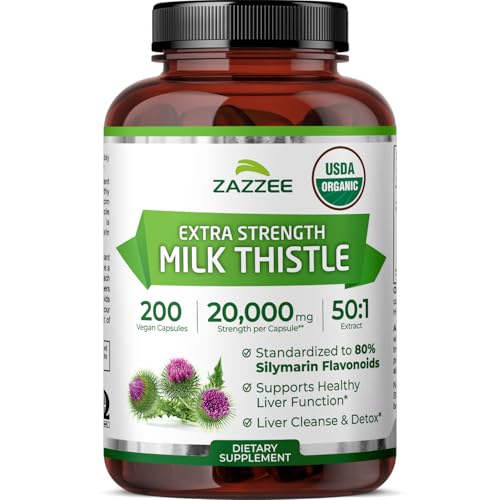
🛒 Where to Buy Milk Thistle (Silymarin)

- CleanseParasites Heavy Metal + Microplastics Binder Editor’s Pick
Contains milk thistle alongside spirulina, zeolite, and other binder herbs. - Thorne Siliphos (Silybin Phosphatidylcholine Complex)
capsules, 1 capsule (~120mg silybin-phosphatidylcholine complex) — Phospholipid complex form (silybin bound to phosphatidylcholine) for liver support - Jarrow Formulas Milk Thistle 150mg (Silymarin Standardized Extract)
capsules, 1 capsule (150mg, 80% silymarin) — Widely used, standard 80% silymarin extract at an accessible price - NOW Foods Silymarin Milk Thistle Extract 150mg
capsules, 1 capsule (150mg, 80% silymarin) — Made under NOW’s GMP Quality Assured program, budget-friendly staple brand with consistent standardization - Nature’s Way Milk Thistle Thisilyn Standardized Extract
capsules, 1 capsule (175mg, 80% silymarin) — Long-running standardized formula, one of the most established milk thistle brands in the US market
As an Amazon Associate we earn from qualifying purchases. Quality varies widely — always choose a product with a published third-party test (COA) before buying.
A Note on the Evidence
Most of the direct interaction evidence here comes from animal and laboratory models, with only limited controlled human data (rosuvastatin); people on statins, especially those with diagnosed liver disease or ragweed/Asteraceae allergies, should consult a physician or pharmacist before adding milk thistle. This article is informational and not a substitute for individualized medical advice.
Frequently Asked Questions
Does milk thistle make statins less effective?
The evidence doesn’t point to a simple less-effective or more-effective answer. Silymarin can alter statin exposure by competing at liver transport proteins [1][2], which could mean higher or lower drug levels depending on the statin and dose, not a uniform reduction in effect.
Which statins are most likely to interact with milk thistle?
Statins that depend heavily on OATP1B1/1B3 for liver uptake, such as rosuvastatin and simvastatin, are the ones studied so far [3][4]. Statins not yet studied this way shouldn’t be assumed safe by default.
Is this interaction based on human studies or just animal/lab data?
Both. There’s a controlled human pharmacokinetic study on rosuvastatin and silymarin [4], alongside rat data on simvastatin [3] and mechanistic work in transgenic mouse models [5] and human transporter systems [1][2].
Could milk thistle affect cholesterol independent of statins?
There’s early laboratory evidence that silibinin influences lipid metabolism pathways in liver cells in a different drug context [6]. This isn’t the same as a cholesterol-lowering claim for milk thistle itself, but it does suggest silibinin isn’t metabolically neutral in the liver.
Should I stop taking milk thistle if I'm on a statin?
That’s a decision for your prescriber, not something this article can answer for you. It depends on your specific statin, dose, liver function, and other medications. Bring the specific PMIDs or this summary to that conversation.
Is milk thistle FDA-approved for liver support?
No. Milk thistle supplements are not evaluated by the FDA for safety or effectiveness and are not intended to diagnose, treat, cure, or prevent any disease.
References
- Köck K et al. Interaction of silymarin flavonolignans with organic anion-transporting polypeptides. Drug metabolism and disposition: the biological fate of chemicals (2013). PMID 23401473
- Lynch KD et al. Hepatic organic anion transporting polypeptides mediate disposition of milk thistle flavonolignans and pharmacokinetic silymarin-drug interactions. Phytotherapy research : PTR (2021). PMID 33587330
- Li Y et al. Effects of Silymarin on the In Vivo Pharmacokinetics of Simvastatin and Its Active Metabolite in Rats. Molecules (Basel, Switzerland) (2019). PMID 31035343
- Deng JW et al. Effect of silymarin supplement on the pharmacokinetics of rosuvastatin. Pharmaceutical research (2008). PMID 18236139
- Bechtold BJ et al. Rifampin- and Silymarin-Mediated Pharmacokinetic Interactions of Exogenous and Endogenous Substrates in a Transgenic OATP1B Mouse Model. Molecular pharmaceutics (2024). PMID 38529622
- Verdura S et al. Silibinin Suppresses the Hyperlipidemic Effects of the ALK-Tyrosine Kinase Inhibitor Lorlatinib in Hepatic Cells. International journal of molecular sciences (2022). PMID 36077379
These statements have not been evaluated by the Food and Drug Administration. This information is not intended to diagnose, treat, cure, or prevent any disease. Content is for informational purposes only and is not medical advice; consult a qualified healthcare provider before starting any supplement. As an Amazon Associate we earn from qualifying purchases.