Drug-induced liver injury (DILI) is one of the more common reasons medications get pulled from the market or flagged with warnings, and it’s a recognized risk with everything from antituberculosis drugs to acetaminophen to newer cystic fibrosis therapies [1]. Because DILI can range from mild enzyme elevations to acute liver failure, there’s ongoing interest in whether supportive compounds, including botanical extracts, might reduce the risk or severity of injury when a needed medication is unavoidable.
Milk thistle (Silybum marianum) seed extract, standardized to silymarin and its main active component silibinin (also called silybin), is the most studied botanical in this space. This article reviews what the available research says about milk thistle and drug-induced liver injury specifically, distinguishes between mechanistic/animal data and human trial data, and is honest about where the evidence is thin. It is not medical advice, and milk thistle is not FDA-evaluated to prevent or treat any disease.
Key Takeaways
- Silymarin’s proposed liver-protective effects come from antioxidant, membrane-stabilizing, and mild anti-inflammatory mechanisms on hepatocytes, plus modulation of CYP450 enzymes like CYP2E1 [2].
- The strongest human clinical signal specific to drug-induced liver injury is a meta-analysis showing silymarin reduced anti-tuberculosis drug-induced liver injury when used prophylactically [3].
- Most other supporting evidence comes from cell culture and animal toxin models (acetaminophen, CCl4, emodin, tert-butyl hydroperoxide), which show consistent hepatoprotective signals but don’t directly prove effectiveness against every drug-induced injury in humans [2] [4] [5] [6].
- Silymarin’s effect on CYP450 metabolism, the same property behind its proposed protective mechanism, is also why it can interact with CYP450-metabolized medications, including some statins, diabetes drugs, and hormonal therapies.
- Research interest is expanding into newer drug classes and delivery methods, but evidence for many specific modern drugs (e.g., CFTR modulator combinations) is still at the model-system stage, not human outcome data [7].
How Milk Thistle Is Thought to Protect the Liver
Silymarin’s flavonolignans, primarily silybin/silibinin, are proposed to act through several overlapping mechanisms rather than a single pathway: antioxidant activity that neutralizes reactive oxygen species generated during drug metabolism, membrane-stabilizing effects on hepatocytes, and mild anti-inflammatory activity [8]. Reviews of silibinin’s toxicology describe these combined actions as the basis for its long history of use as a hepatoprotective agent against a range of chemical and natural toxins [9].
One specific mechanism relevant to drug-induced injury is silymarin’s effect on cytochrome P450 enzymes, particularly CYP2E1, which metabolizes acetaminophen into its toxic reactive intermediate. In an animal model of acetaminophen-induced acute liver injury, silymarin was shown to downregulate both the expression and activity of CYP2E1, which is proposed as one route by which it may reduce the formation of hepatotoxic metabolites [2]. This CYP-modulating property is also the basis of caution around drug interactions, since a compound that changes CYP450 activity can in principle alter the metabolism of other CYP450-dependent medications.

Metabolomic work in rodent models has also been used to characterize how liver injury unfolds at the level of small-molecule chemistry and how silybin treatment shifts that metabolic signature back toward normal. In a model of emodin-induced liver injury, researchers used mass spectrometry-based metabolic profiling to map the injury and silybin’s modifying effect on it, offering a mechanistic (rather than clinical) picture of protection [5].
Cell-Based and Animal Evidence for Hepatoprotection
Much of the foundational evidence for milk thistle’s hepatoprotective claims comes from cell culture and animal studies rather than human trials of DILI specifically. In HepG2 liver cells exposed to tert-butyl hydroperoxide (a standard oxidative-stress toxicity model), flavonoids isolated from a related milk thistle species (Cirsium japonicum var. maackii) reduced markers of hepatotoxicity, supporting the general antioxidant mechanism proposed for silymarin-family compounds [6].
In a rat model of carbon tetrachloride (CCl4)-induced hepatotoxicity, a chemical model widely used to study acute liver injury, silymarin delivered as a phytosome formulation (a delivery method meant to improve absorption) was compared against standard milk thistle extract and showed antioxidant and hepatoprotective effects, with the phytosome form performing favorably relative to the standard extract [4]. This line of research is useful for understanding formulation and bioavailability questions, but CCl4 and similar chemical-toxin models are not the same as real-world drug-induced injury in humans, and results don’t automatically translate.

Broader reviews of milk thistle’s antidotal and protective properties describe consistent hepatoprotective signals across many toxin models (heavy metals, industrial chemicals, and pharmaceutical agents alike), while also noting that the strength of evidence varies a great deal depending on the specific toxin and study design [8].
Human Trial Evidence: Antituberculosis Drug-Induced Liver Injury
The clearest human clinical evidence for milk thistle in a specific DILI context comes from antituberculosis (anti-TB) drug therapy, where hepatotoxicity is a well-recognized complication of first-line regimens. A meta-analysis of randomized controlled trials evaluated silymarin given prophylactically alongside anti-TB drugs and found evidence supporting its use in reducing the incidence of drug-induced liver injury in this population [3].
This is meaningful because it’s a meta-analysis of RCTs in real patients taking a known hepatotoxic drug regimen, rather than a cell or animal model. That said, meta-analyses of this kind are only as strong as the trials feeding into them, and anti-TB DILI is a fairly specific clinical scenario; the finding shouldn’t be generalized to every drug class or every patient population without more direct research.
Emerging and Adjacent Research Contexts
Interest in nutraceuticals, including milk thistle-derived compounds, as adjunctive strategies against DILI is expanding into newer drug classes. A 2024 review discusses the therapeutic potential of nutraceuticals broadly (not milk thistle alone) in the context of drug-induced liver injury, situating silymarin among a wider set of compounds being studied for hepatoprotective potential [10].

Newer investigative models are also being applied to specific modern drugs. For example, a liver-on-chip model has been used to study drug-induced liver injury associated with the cystic fibrosis combination therapy elexacaftor/tezacaftor/ivacaftor [7]. This kind of research reflects how DILI evaluation methods are evolving, but it is a model-system study of a specific drug’s hepatotoxicity rather than direct evidence that milk thistle mitigates that particular drug’s liver risk.
A separate strand of interest involves milk thistle as a supportive therapy in oncology, where chemotherapy-associated liver stress is a concern; a review discusses its potential supportive role in that setting [11]. Again, this is a different clinical context from acute DILI from a single hepatotoxic drug, but it illustrates the same underlying hepatoprotective rationale being explored across therapeutic areas.
What the Flavonolignan Chemistry Tells Us About Consistency
Silymarin is not a single molecule but a complex of flavonolignans, and research into the “non-taxifolin”-derived flavonolignans (i.e., silymarin components beyond the most basic building block) has cataloged meaningful chemical and biological diversity within the silymarin complex [12]. This matters practically: different milk thistle extracts and supplements can vary in their flavonolignan ratios and total silymarin content depending on sourcing and standardization, which is one reason results across studies (and across commercial products) aren’t always directly comparable.
This chemical complexity is also part of why researchers are interested in improved delivery methods, such as the phytosome formulation tested against standard extract in the CCl4 rat model discussed above [4], since silymarin’s bioavailability from plain extract is known to be limited.
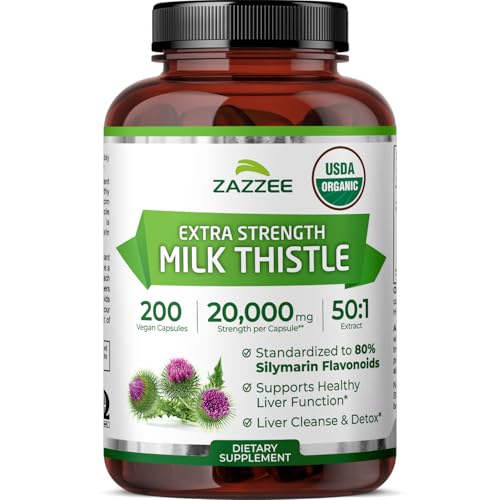
🛒 Where to Buy Milk Thistle (Silymarin)
- CleanseParasites Heavy Metal + Microplastics Binder Editor’s Pick
Contains milk thistle alongside spirulina, zeolite, and other binder herbs. - Thorne Siliphos (Silybin Phosphatidylcholine Complex)
capsules, 1 capsule (~120mg silybin-phosphatidylcholine complex) — Phospholipid complex form (silybin bound to phosphatidylcholine) for liver support - Jarrow Formulas Milk Thistle 150mg (Silymarin Standardized Extract)
capsules, 1 capsule (150mg, 80% silymarin) — Widely used, standard 80% silymarin extract at an accessible price - NOW Foods Silymarin Milk Thistle Extract 150mg
capsules, 1 capsule (150mg, 80% silymarin) — Made under NOW’s GMP Quality Assured program, budget-friendly staple brand with consistent standardization - Nature’s Way Milk Thistle Thisilyn Standardized Extract
capsules, 1 capsule (175mg, 80% silymarin) — Long-running standardized formula, one of the most established milk thistle brands in the US market
As an Amazon Associate we earn from qualifying purchases. Quality varies widely — always choose a product with a published third-party test (COA) before buying.
A Note on the Evidence
Most of the supporting evidence for milk thistle in drug-induced liver injury comes from cell culture and animal studies rather than large human trials, with the anti-tuberculosis drug context being the notable exception; findings shouldn’t be assumed to generalize to every medication. Milk thistle supplements are not FDA-evaluated for safety or effectiveness, are not intended to diagnose, treat, cure, or prevent any disease, and can interact with CYP450-metabolized medications; anyone with diagnosed liver disease, a ragweed/Asteraceae allergy, or who takes prescription medications should consult a physician before use.

Frequently Asked Questions
Does milk thistle prevent drug-induced liver injury?
There isn’t broad evidence that milk thistle prevents DILI across all drugs. The clearest human data is specific to prophylactic silymarin use alongside antituberculosis drug therapy, where a meta-analysis of randomized trials found a protective effect [3]. For most other drug classes, the supporting evidence is from cell and animal models rather than human trials.
How is milk thistle thought to protect liver cells from drug toxicity?
Proposed mechanisms include antioxidant activity, stabilizing hepatocyte cell membranes, mild anti-inflammatory effects, and altering CYP450 enzyme activity (such as CYP2E1) involved in converting some drugs into toxic metabolites [2] [8].
Can milk thistle help with acetaminophen-related liver injury specifically?
In an animal model, silymarin reduced markers of acetaminophen-induced liver injury partly by downregulating CYP2E1, the enzyme responsible for producing acetaminophen’s toxic metabolite [2]. This is preclinical evidence, not a substitute for standard acetaminophen overdose treatment, which should always be managed medically.

Is milk thistle safe to take with prescription medications?
Not necessarily. Because silymarin can affect CYP450 enzyme activity, it may interact with CYP450-metabolized drugs, including some statins, diabetes medications, and hormonal therapies. Anyone on prescription medication, especially one already associated with liver risk, should talk to a physician before adding milk thistle.
Does the form of milk thistle extract matter?
Silymarin is a complex of multiple flavonolignans, not one molecule, and its natural bioavailability is limited [12]. Formulation approaches like phytosomes have been studied to improve absorption and showed favorable antioxidant and hepatoprotective effects compared to standard extract in one animal model [4], though this doesn’t establish superiority in humans.
Is milk thistle a substitute for medical monitoring during drug therapy?
No. Even in the anti-tuberculosis trials where silymarin showed a protective association, it was studied as an adjunct alongside standard drug therapy and monitoring, not as a replacement for either [3]. Routine liver function monitoring remains the standard of care for anyone on a known hepatotoxic drug regimen.
References
- Rani J et al. Drug-induced liver injury and anti-hepatotoxic effect of herbal compounds: a metabolic mechanism perspective. Phytomedicine : international journal of phytotherapy and phytopharmacology (2024). PMID 37913641
- Yang W et al. Silymarin Protects against Acute Liver Injury Induced by Acetaminophen by Downregulating the Expression and Activity of the CYP2E1 Enzyme. Molecules (Basel, Switzerland) (2022). PMID 36557984
- Tao L et al. Prophylactic Therapy of Silymarin (Milk Thistle) on Antituberculosis Drug-Induced Liver Injury: A Meta-Analysis of Randomized Controlled Trials. Canadian journal of gastroenterology & hepatology (2019). PMID 30733935
- El-Gazayerly ON et al. Antioxidant and hepatoprotective effects of silymarin phytosomes compared to milk thistle extract in CCl4 induced hepatotoxicity in rats. Journal of microencapsulation (2014). PMID 23808477
- Chen C et al. Metabolic profiling of emodin drug-induced liver injury and silybin treatment in rats using ultra-performance liquid chromatography-quadrupole-time-of-flight-mass spectrometry: A metabolomic and mechanistic approach. Biomedical chromatography : BMC (2022). PMID 35904380
- Jung HA et al. Protective effects of flavonoids isolated from Korean milk thistle Cirsium japonicum var. maackii (Maxim.) Matsum on tert-butyl hydroperoxide-induced hepatotoxicity in HepG2 cells. Journal of ethnopharmacology (2017). PMID 28735729
- Shi A et al. Evaluation of Elexacaftor/Tezacaftor/Ivacaftor-Mediated Drug-Induced Liver Injury Using a Liver-On-Chip Model. Clinical and translational science (2025). PMID 41222452
- Fanoudi S et al. Milk thistle (Silybum Marianum) as an antidote or a protective agent against natural or chemical toxicities: a review. Drug and chemical toxicology (2020). PMID 30033764
- Horowitz BZ et al. Silibinin: a toxicologist's herbal medicine?. Clinical toxicology (Philadelphia, Pa.) (2022). PMID 36222816
- Sethi N et al. Therapeutic Potential of Nutraceuticals against Drug-Induced Liver Injury. Seminars in liver disease (2024). PMID 39393795
- Frassová Z et al. [Milk Thistle (Silybum Marianum) as a Supportive Phytotherapeutic Agent in Oncology]. Klinicka onkologie : casopis Ceske a Slovenske onkologicke spolecnosti (2017). PMID 29271213
- Chambers CS et al. "Non-Taxifolin" Derived Flavonolignans: Phytochemistry and Biology. Current pharmaceutical design (2015). PMID 26429716
These statements have not been evaluated by the Food and Drug Administration. This information is not intended to diagnose, treat, cure, or prevent any disease. Content is for informational purposes only and is not medical advice; consult a qualified healthcare provider before starting any supplement. As an Amazon Associate we earn from qualifying purchases.