Milk thistle extract, standardized to silymarin and its main component silibinin, is one of the most commonly used liver-support supplements. Because it’s marketed as a liver herb, people often assume it’s automatically safe to combine with prescription drugs that are also processed by the liver. That assumption isn’t quite right, and the actual research is more nuanced than either ‘totally safe’ or ‘dangerous.’
The concern centers on the cytochrome P450 (CYP450) enzyme family, the group of liver enzymes responsible for metabolizing roughly three-quarters of all prescription drugs, along with the P-glycoprotein (P-gp) transporter that controls how much of a drug gets absorbed and where it goes in the body. This article walks through what laboratory and clinical studies have found about silymarin’s effect on these systems, which drug classes are most often flagged, and where the evidence is strong versus still preliminary.
Key Takeaways
- Silymarin’s flavonolignans have documented in vitro inhibitory activity against several CYP450 isoforms (2C9, 2C19, 2D6, 3A4) and can modulate P-glycoprotein transport [1] [2]
- Clinical (human) studies suggest the real-world magnitude of these interactions is often smaller than lab data alone would predict, though not zero [3] [4]
- Medications metabolized by CYP3A4 or CYP2C9, including some statins, calcium channel blockers, and diabetes drugs, are the categories most worth discussing with a physician or pharmacist
- Silybin is itself metabolized by CYP2C8, meaning the interaction picture works in both directions [5]
- This research area is still evolving; dose, formulation, and individual metabolism all affect real-world risk
What CYP450 Enzymes Do and Why They Matter
CYP450 enzymes, especially isoforms like CYP3A4, CYP2C9, CYP2C19, and CYP2D6, break down the majority of oral medications so they can be cleared from the body. When a substance inhibits one of these enzymes, drugs that rely on it for clearance can build up to higher-than-intended blood levels. When a substance induces (speeds up) an enzyme, the opposite happens: the drug clears too fast and may lose effectiveness. Either direction can change how a medication behaves in the body, which is why herb-drug interactions involving CYP450 are taken seriously in pharmacology research [6].
Silymarin’s flavonolignans (silybin/silibinin and related compounds) have been studied specifically for their ability to inhibit several CYP450 isoforms in laboratory (in vitro) models, which is the first step researchers use to flag a potential real-world interaction risk [7].

Laboratory Evidence: Silymarin's Effects on Specific CYP Isoforms
In human liver microsome studies, silibinin has shown inhibitory activity against multiple CYP450 enzymes, suggesting a mechanistic basis for interaction concerns even before any drug is involved [8]. A newer 2021 study looking at silymarin components and their sulfate metabolites found interactions with CYP2C9, CYP2C19, CYP2D6, and CYP3A4, the same isoforms responsible for metabolizing a large share of commonly prescribed drugs [1].
Silybin itself is also a substrate, meaning the body’s own CYP2C8 enzyme metabolizes silybin as it processes it [5]. That two-way relationship, silymarin both being broken down by CYP enzymes and inhibiting some of them, is part of what makes predicting individual interactions complex rather than one-directional.
An earlier assessment of drug-drug interaction potential for silymarin reinforced that in vitro inhibition signals exist across several CYP pathways, though the clinical magnitude of that inhibition varies by enzyme and by dose [9].
Beyond CYP450: The P-glycoprotein (P-gp) Transporter
CYP450 isn’t the only system involved. P-glycoprotein is a transport protein in the gut and liver that pumps certain drugs back out of cells, limiting how much of the drug the body absorbs. Herbal compounds, including flavonolignans in milk thistle, have been studied for their ability to modulate P-gp activity, which can independently raise or lower blood levels of P-gp-substrate drugs regardless of what’s happening with CYP450 [2].

Research specifically looking at MDR (multidrug resistance transporter, a term for P-gp) and CYP3A4-mediated herb-drug interactions has grouped milk thistle among herbs worth monitoring because the two systems, CYP3A4 metabolism and P-gp transport, often act on the same drugs simultaneously, compounding the uncertainty [10].
What Human Clinical Studies Actually Show
Laboratory findings don’t always translate into a meaningful effect in real people, and this is where milk thistle’s story gets more reassuring than the in vitro data alone might suggest. A clinical pharmacokinetic study specifically testing silymarin’s effect on oral nifedipine, a CYP3A4-metabolized calcium channel blocker, found the interaction in living subjects to be modest [3].
A broader review of herbal supplements as ‘perpetrators’ of pharmacokinetic drug interactions in clinical settings placed milk thistle in a lower-risk category compared to herbs like St. John’s Wort, noting that despite clear in vitro CYP inhibition, clinical dosing of silymarin has generally produced smaller real-world effects on co-administered drugs than the lab data alone would predict [4]. This is an important distinction: the concern is real enough to warrant caution, but it hasn’t been shown to be as dramatic in practice as some other herbal supplements.
Drug Classes Where Caution Is Reasonable
Given the mechanistic evidence above, the categories most often discussed alongside milk thistle include CYP3A4-metabolized medications (many statins, some calcium channel blockers like nifedipine [3], and certain hormonal therapies), CYP2C9-metabolized drugs (some diabetes medications and blood thinners) [6], and drugs that are also P-gp substrates [2] [10]. This isn’t a claim that milk thistle will meaningfully interfere with all of these in every person; it’s a reflection of which pathways have documented sensitivity to silymarin in the lab.

Structurally related flavonolignan analogues have also been evaluated specifically for their drug-interaction liability as part of medicinal chemistry work, underscoring that this is an active area of pharmacological research rather than settled science [11].
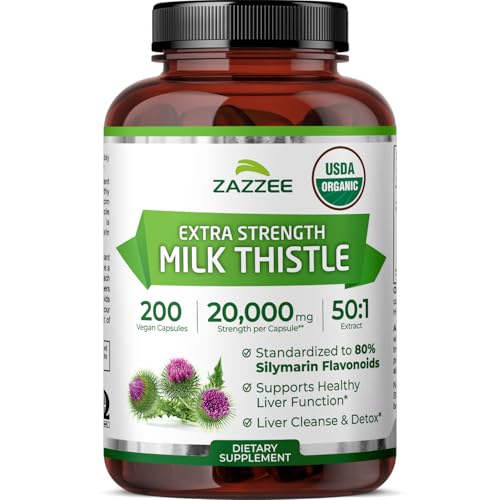
🛒 Where to Buy Milk Thistle (Silymarin)
- CleanseParasites Heavy Metal + Microplastics Binder Editor’s Pick
Contains milk thistle alongside spirulina, zeolite, and other binder herbs. - Thorne Siliphos (Silybin Phosphatidylcholine Complex)
capsules, 1 capsule (~120mg silybin-phosphatidylcholine complex) — Phospholipid complex form (silybin bound to phosphatidylcholine) for liver support - Jarrow Formulas Milk Thistle 150mg (Silymarin Standardized Extract)
capsules, 1 capsule (150mg, 80% silymarin) — Widely used, standard 80% silymarin extract at an accessible price - NOW Foods Silymarin Milk Thistle Extract 150mg
capsules, 1 capsule (150mg, 80% silymarin) — Made under NOW’s GMP Quality Assured program, budget-friendly staple brand with consistent standardization - Nature’s Way Milk Thistle Thisilyn Standardized Extract
capsules, 1 capsule (175mg, 80% silymarin) — Long-running standardized formula, one of the most established milk thistle brands in the US market
As an Amazon Associate we earn from qualifying purchases. Quality varies widely — always choose a product with a published third-party test (COA) before buying.
A Note on the Evidence
Much of the CYP450 interaction evidence for milk thistle comes from laboratory (in vitro) studies rather than large human trials, and individual response can vary by dose, formulation, and personal metabolism. Milk thistle supplements are not evaluated by the FDA for safety or effectiveness and are not intended to diagnose, treat, cure, or prevent any disease; anyone taking prescription medications, especially statins, diabetes drugs, or hormonal therapies, or who has liver disease or a ragweed/Asteraceae allergy, should consult a physician before use. This article is informational and not a substitute for medical advice.
Frequently Asked Questions
Does milk thistle interact with statins?
Statins metabolized via CYP3A4 are a category flagged by laboratory CYP450 inhibition data [1] [10], though large-scale human interaction studies specific to statins and milk thistle are limited. Anyone on statin therapy should mention milk thistle use to their prescriber.
Is milk thistle safe with blood pressure medication?
A clinical study on nifedipine, a CYP3A4-metabolized calcium channel blocker, found a modest pharmacokinetic interaction with silymarin in human subjects [3]. This suggests caution rather than an outright contraindication, but it should be discussed with a doctor.
Can milk thistle affect blood thinners or diabetes medication?
Some diabetes medications rely on CYP2C9 for clearance, an enzyme shown to interact with silymarin components in vitro [1] [6]. Because altered clearance of these drugs carries real clinical stakes (bleeding risk, blood sugar swings), this combination warrants direct medical guidance rather than self-management.

Why do lab studies show a bigger interaction risk than real-world use?
In vitro (test tube/microsome) studies use isolated enzymes and controlled concentrations that don’t always reflect how much active compound reaches the liver after oral dosing, absorption, and first-pass metabolism in a whole person. Clinical reviews have found milk thistle’s real-world interaction effects to generally be smaller than lab-only predictions [4], though smaller isn’t the same as none.
What is P-glycoprotein and why does it matter for milk thistle?
P-glycoprotein is a transporter protein that pumps certain drugs out of cells, affecting how much medication the body absorbs. Milk thistle compounds have been studied for modulating P-gp activity independent of CYP450 effects, which means the two mechanisms can compound for drugs that are substrates of both systems [2] [10].
Who should be most careful about combining milk thistle with medications?
People on CYP3A4 or CYP2C9-metabolized prescriptions, those with diagnosed liver disease, and anyone with a ragweed or Asteraceae plant family allergy (milk thistle is in that family) should talk to a physician or pharmacist before starting milk thistle, particularly if they take medications with a narrow therapeutic window.
References
- Faisal Z et al. Interaction of silymarin components and their sulfate metabolites with human serum albumin and cytochrome P450 (2C9, 2C19, 2D6, and 3A4) enzymes. Biomedicine & pharmacotherapy = Biomedecine & pharmacotherapie (2021). PMID 33706132
- Zhou S et al. Herbal modulation of P-glycoprotein. Drug metabolism reviews (2004). PMID 15072439
- Fuhr U et al. The effect of silymarin on oral nifedipine pharmacokinetics. Planta medica (2007). PMID 17968815
- Hermann R et al. Clinical evidence of herbal drugs as perpetrators of pharmacokinetic drug interactions. Planta medica (2012). PMID 22855269
- Jancová P et al. Silybin is metabolized by cytochrome P450 2C8 in vitro. Drug metabolism and disposition: the biological fate of chemicals (2007). PMID 17670841
- Zhou SF et al. Substrates, inducers, inhibitors and structure-activity relationships of human Cytochrome P450 2C9 and implications in drug development. Current medicinal chemistry (2009). PMID 19515014
- Baer-Dubowska W et al. Inhibition of murine hepatic cytochrome P450 activities by natural and synthetic phenolic compounds. Xenobiotica; the fate of foreign compounds in biological systems (1998). PMID 9741952
- Beckmann-Knopp S et al. Inhibitory effects of silibinin on cytochrome P-450 enzymes in human liver microsomes. Pharmacology & toxicology (2000). PMID 10895987
- Doehmer J et al. Assessment of drug-drug interaction for silymarin. Toxicology in vitro : an international journal published in association with BIBRA (2008). PMID 18249085
- Pal D et al. MDR- and CYP3A4-mediated drug-herbal interactions. Life sciences (2006). PMID 16442130
- Althagafy HS et al. Semisynthesis, cytotoxicity, antiviral activity, and drug interaction liability of 7-O-methylated analogues of flavonolignans from milk thistle. Bioorganic & medicinal chemistry (2013). PMID 23673225
These statements have not been evaluated by the Food and Drug Administration. This information is not intended to diagnose, treat, cure, or prevent any disease. Content is for informational purposes only and is not medical advice; consult a qualified healthcare provider before starting any supplement. As an Amazon Associate we earn from qualifying purchases.